
Oliver Stone
If June was defined by the Iran peace deal and collapsing oil prices, July promptly reminded everyone that the Middle East situation is far from resolved. Brent crude and natural gas prices surged back, chip stocks had their worst month since the 2025 tariff shock, and the Bank of England found itself caught between a softening domestic economy and an energy price outlook it openly admitted it cannot predict.
For UK investors, the month produced a surprisingly mixed set of outcomes, with the FTSE 100 a genuine bright spot and the rest of the world a good deal more complicated.
In GBP terms, the equity market picture for July was highly bifurcated. The UK was the standout performer among developed markets, with the FTSE 100 gaining 3.5% while the mid-cap FTSE 250 index gained just over 6%. The region’s significant exposure to energy stocks was a major tailwind as oil prices rebounded sharply; a reversal of the drag it suffered in June. Commodity and mining stocks also contributed, making July a month where the UK’s older-economy composition worked firmly in its favour:
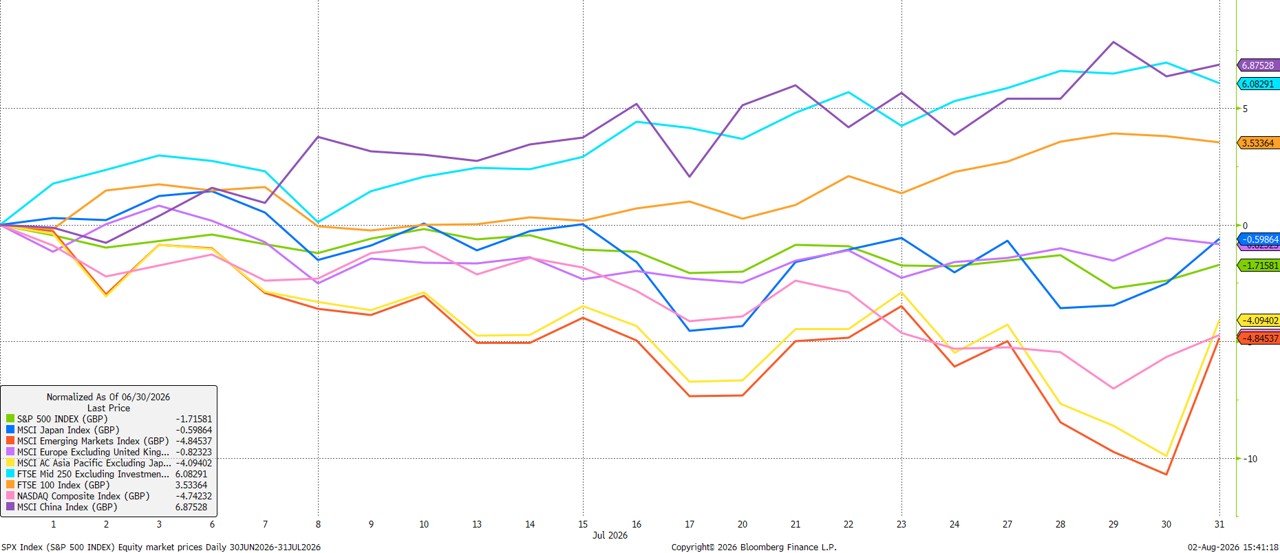
The big story globally was the collapse in semiconductor stocks. A mid-month weekend of renewed Middle East attacks and counterstrikes rattled markets, and a breakthrough from Chinese AI startup Moonshot further dented confidence in the AI spending narrative. South Korean chipmakers SK Hynix and Samsung fell 15% and 11% respectively on 13 July, dragging the broader chip sector into bear market territory – down more than 20% from its record high. It was the worst month for the group since the April 2025 US tariff meltdown.
This weighed heavily on US equities, with the S&P 500 ending the month down 1.7% and the NASDAQ down 4.7% in pound terms as sterling also strengthened against the dollar. A late rally on the final day of the month, driven by strong Amazon earnings, prevented a worse outcome.
European and Japanese equities were down slightly on the month, while emerging markets and Asia had difficult months, both down between 4-5%, with the chip-heavy South Korean market a significant drag.
The surprise package was MSCI China, up 6.90% in GBP terms – a sharp reversal after months of pain. China’s reflation story showed tentative signs of stabilising, and sentiment towards Chinese equities improved as commodity input cost pressures eased following the Iran ceasefire. Whether this marks a genuine turning point or a bear market bounce remains to be seen.
July was a painful month for bond investors, with losses seen across the board, and concentrated in developed market government bond indices. The 10-year gilt yield rose from 4.76% to 5.05% as rising oil prices reignited inflation concerns and markets grappled with the possibility of further rate hikes. The 10-year US Treasury yield moved similarly, climbing from 4.47% to 4.74%.
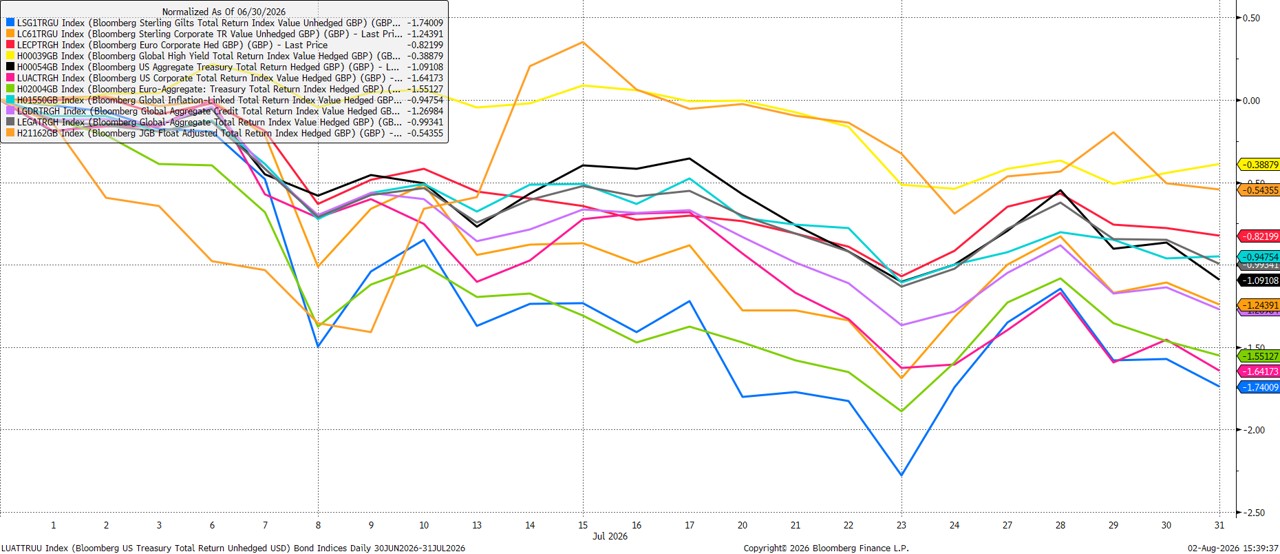
The Bank of England’s July meeting on 30th July was the domestic highlight. The MPC voted 6-3 to hold rates at 3.75%, with Catherine Mann joining Megan Greene and Chief Economist Huw Pill in voting for a quarter-point increase. Governor Andrew Bailey played down the prospect of imminent hikes, pointing to a slow softening in the labour market and gradual disinflation. While short-dated gilts rallied sharply on his comments, the longer end of the gilt market remained under pressure throughout the month, driven by the oil price surge and the broader global yield move.
Pill’s warning on the final day of the month captured the dilemma well: energy and commodity price volatility stemming from the Iran situation could persist into 2027, making the inflation outlook “profoundly uncertain.” The BoE’s implicit message is that external forces – the Iran war and US tariff policy – are the main obstacle to rate cuts, not domestic conditions. That’s a frustrating position for UK borrowers, but it does suggest the committee’s bias remains towards easing once the fog clears.
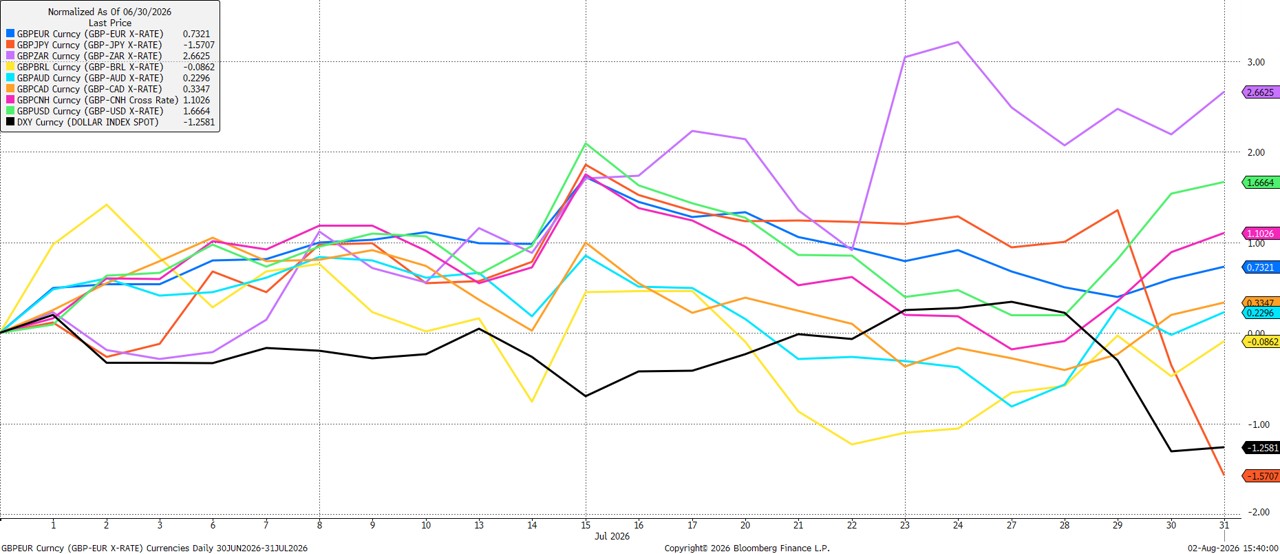
Sterling had a good month in the currency markets, rising by around 1.7% versus the US dollar which itself weakened broadly. The Fed held rates at its July meeting but Federal Reserve Chair Kevin Warsh offered little clarity on the future policy framework, disappointing markets that had been positioned for a more decisively hawkish signal. The dollar logged its worst week in over three months in the final week of July on concerns that the Fed may not move forcefully enough to contain inflation.
Against the euro, sterling also edged higher by around 0.8%. For UK investors, the stronger pound was a headwind on unhedged overseas equity exposure, amplifying the losses on US and European allocations in GBP terms.
The yen was the most dramatic FX story of the month. It remained under pressure for most of July before Japanese and US authorities reportedly conducted direct yen-buying intervention on 31st July for a second consecutive day, sending the currency sharply higher – up more than 1% against both the dollar and the euro on the day:
The most dramatic market move of July was Brent crude’s surge from $72.92 to $90.12 a barrel — a rise of nearly 24% in a single month. This almost entirely reversed June’s collapse. The trigger was a weekend of renewed attacks and counterstrikes in the Middle East in mid-July, which reignited fears over Hormuz shipping disruptions. The stop-start nature of the US-Iran negotiations meant that oil markets remained highly sensitive to any escalation news.
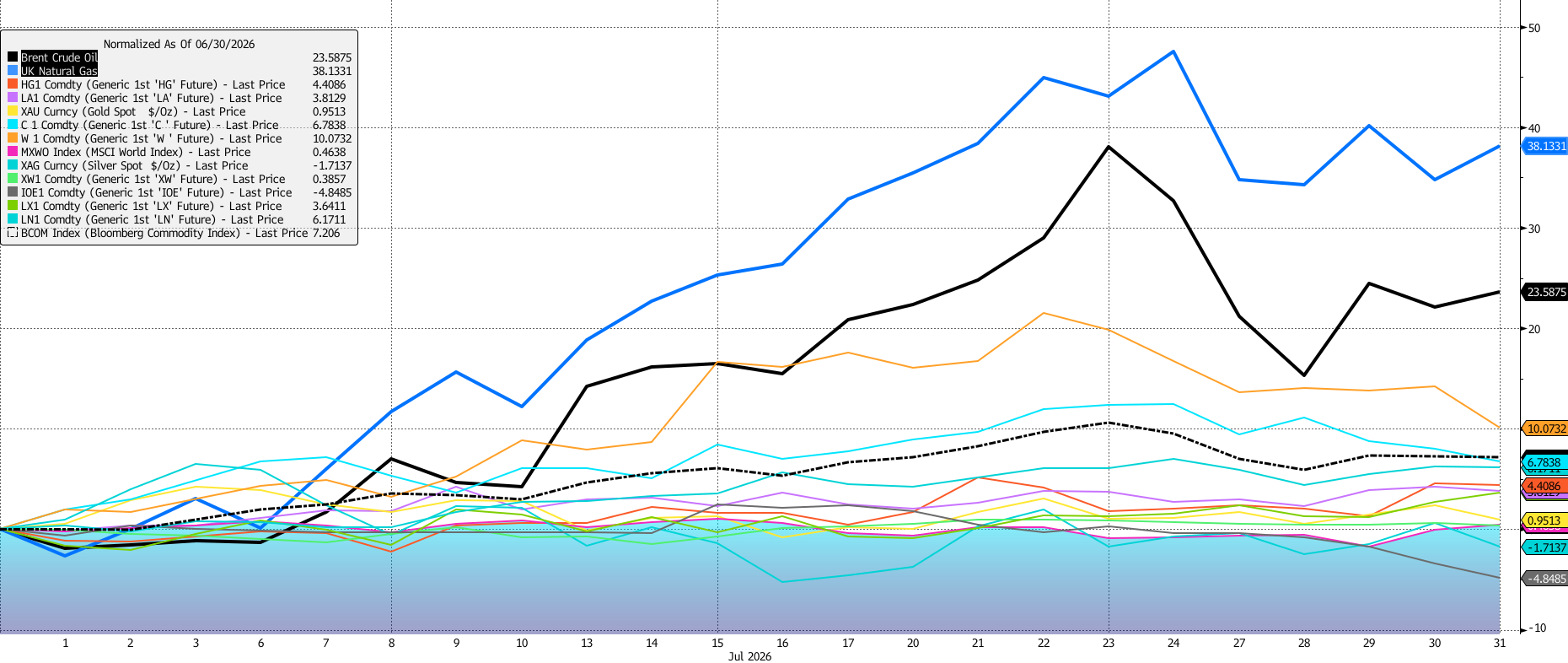
Gold was far more subdued, edging up just under 1% from $4,008 to $4,046 per ounce. With the dollar weakening and geopolitical risk rising again, one might have expected a stronger gold move, but the hawkish yield environment continued to act as a cap on the metal’s upside.
July underlined just how fragile the post-Iran-deal calm was. The ceasefire has not held cleanly, oil is back near $90, bond yields are pushing higher again, and central banks on both sides of the Atlantic are stuck in a difficult holding pattern. For UK investors, the month offered some genuine positives: a strong FTSE, a firmer pound, and a BoE that appears in no rush to tighten further. But the surge in gilt yields was a real headwind for fixed income, and the chip-driven selloff in global tech was a reminder that the AI trade is not a one-way street. Heading into August, the key questions are whether the Iran negotiations stabilise oil prices, whether the Fed eventually acts on inflation, and whether the BoE’s cautious optimism on domestic disinflation proves well-founded.
| Match me to an adviser | Our advisers |
The value of investments may fluctuate in price or value and you may get back less than the amount originally invested. Past performance is not a guide to the future. The views expressed in this publication represent those of the author and do not constitute financial advice.
For further information, please contact:
For further information, please contact:

