Oliver Stone

September was a bruising month for global markets. Oil surged back above $100 a barrel, the Federal Reserve raised interest rates for the first time since 2023, and government bond yields climbed sharply on both sides of the Atlantic. For UK investors, the headline numbers were largely negative, with some nuance underneath the bonnet as sterling’s sharp fall against the dollar and yen cushioned returns on overseas equity holdings, and a pivotal Bank of England decision on quantitative tightening gave gilts a meaningful boost relative to their global peers.
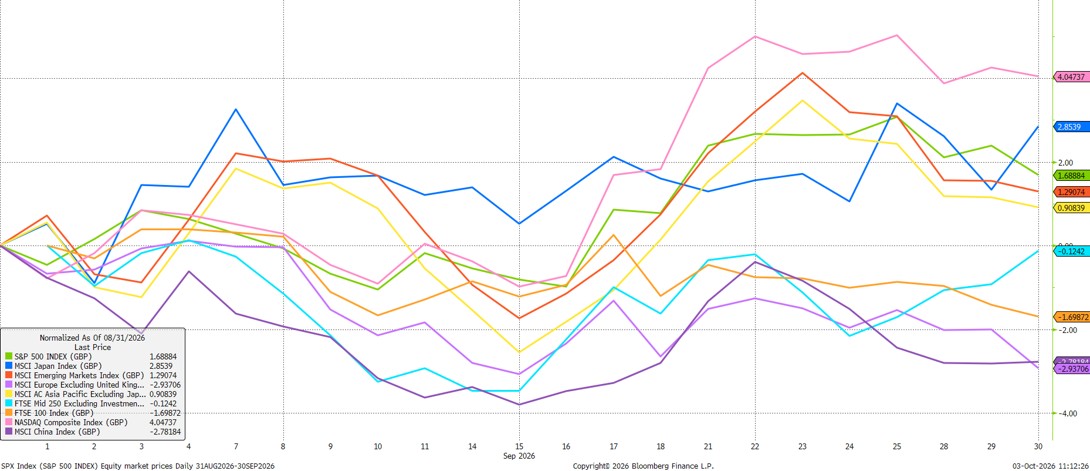
In equities, virtually every major equity market fell in September in local currency terms . But in GBP terms the picture was considerably more mixed, thanks to a weaker pound against the dollar and yen:
| Index | Local Currency Return | GBP Return |
| MSCI Japan | -0.83% (JPY) | +2.85% |
| S&P 500 | -0.45% (USD) | +1.69% |
| MSCI Emerging Markets | -0.84% (USD) | +1.29% |
| FTSE 100 | -2.02% (GBP) | -1.70% |
| MSCI China | -4.73% (HKD) | -2.78% |
| MSCI Europe ex UK | -2.65% (EUR) | -2.94% |
The standout feature of the equity table above is how dramatically the FX effect split outcomes. MSCI Japan fell nearly 1% in yen terms, yet delivered a positive 2.85% return in sterling — entirely because the yen strengthened sharply against the pound during the month. Similarly, the S&P 500 fell in dollar terms but returned 1.69% in GBP terms as sterling weakened against the dollar.
The FTSE 100 was the most straightforward disappointment, falling by 1.70%. The index’s energy exposure, which was a tailwind in July, provided little comfort this time. Despite oil surging, the broader market was weighed down by rising gilt yields, which hit rate-sensitive sectors hard, and by a deteriorating global growth outlook. European equities were the worst performer in GBP terms at 2.94%, with the euro’s slight weakening against sterling adding a small additional headwind on top of a weak local market.
Chinese equities fell by 4.73% in local terms and 2.69% in GBP terms, despite Beijing announcing its biggest stimulus package since 2024. Markets were unimpressed, as the package appeared designed to keep growth on target rather than deliver a genuine demand revival, and investors were left hoping for more meaningful action to address the country’s underlying consumption weakness.
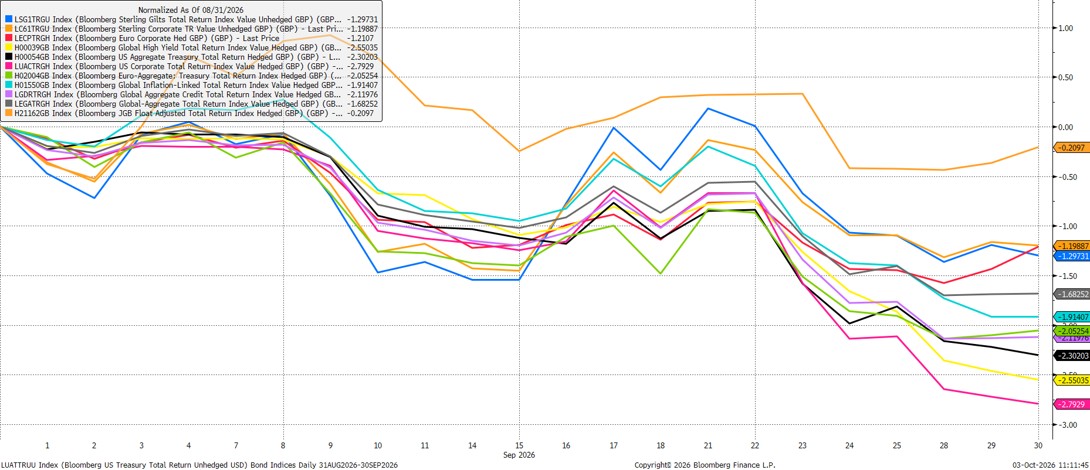
September was a painful month for government bond investors globally. The 10-year US Treasury yield climbed from 4.75% to 5.29% as the Fed’s rate hikes and hawkish forward guidance sent shockwaves through fixed income markets. The 30-year Treasury yield hit its highest level since 2002. UK gilts were not immune, with the 10-year gilt yield rising from 5.06% to 5.42%.
However, sterling fixed income assets significantly outperformed most of their global peers in September, with the reason being a landmark Bank of England decision. At its September meeting, the MPC voted 6-3 to hold rates at 3.75% (as expected), but the real news was the accompanying overhaul of its quantitative tightening programme. The BoE announced it would pause active gilt sales for bonds with maturities beyond 2049, and set out a plan to reduce its gilt stock by £368 billion by end-2034. The 30-year gilt yield fell more than 10 basis points on the day – its biggest single-day drop in four months – having earlier touched its highest level since 1998.
The net result per the chart below was that UK gilts, while still delivering negative total returns on the month, fell considerably less than Treasuries or European government bonds – a meaningful relative win for sterling fixed income portfolios.
The BoE’s tone was cautious rather than dovish. Governor Bailey acknowledged that policy may need to tighten further if the Iran conflict prolongs energy price pressures, and the BoE’s own forecasts pointed to UK inflation slightly above 4% in the first quarter of 2027.
In currencies, September produced one of the most striking bifurcations in sterling’s performance that we have seen in some time. Against the dollar and the yen, the pound fell sharply, but against other major developed market currencies such as the euro, the Canadian dollar and the Australian dollar, it strengthened meaningfully.
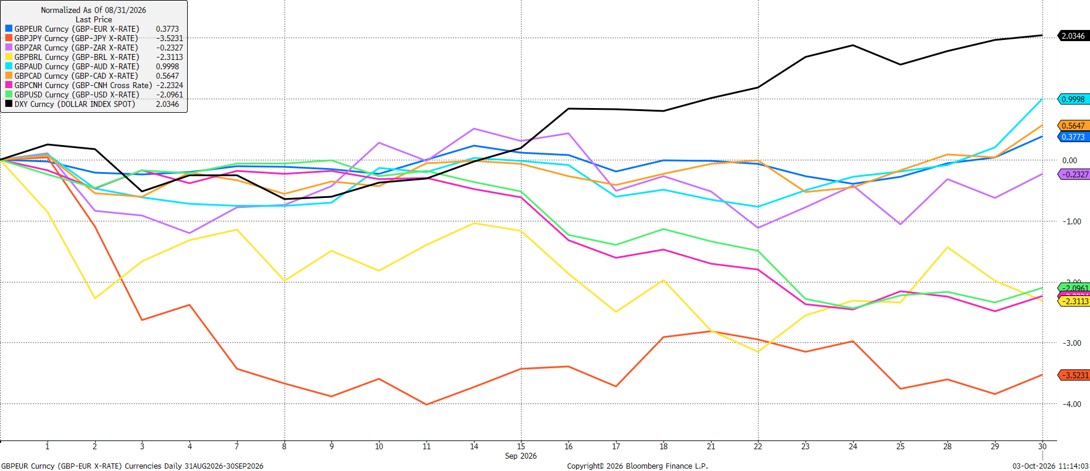
The dollar’s strength was the dominant FX story of the month. The Bloomberg Dollar Spot Index rose by just over 2% in September – its best monthly performance since March – driven almost entirely by the Fed’s rate hike and its signal that further tightening remains on the table. Against that backdrop, sterling’s 2% fall against the dollar is entirely understandable: the interest rate differential moved firmly in the dollar’s favour.
The yen’s strength against sterling is a different story. The Bank of Japan gave no clear signal of consecutive rate hikes at its October meeting, yet the yen strengthened sharply, likely reflecting safe-haven demand as global risk appetite deteriorated and oil-driven inflation fears mounted.
Against the euro, Canadian dollar and Australian dollar, sterling held its own or gained modestly. The euro hit its weakest level in 16 months against the dollar by month-end, dragged lower by the ECB’s own policy uncertainty and weaker eurozone growth data, with that dollar strength pulled the euro down against sterling too. The Canadian and Australian dollars, both commodity-linked currencies, were similarly pressured by global growth concerns despite the oil price surge, leaving sterling in a relatively stronger position against both.
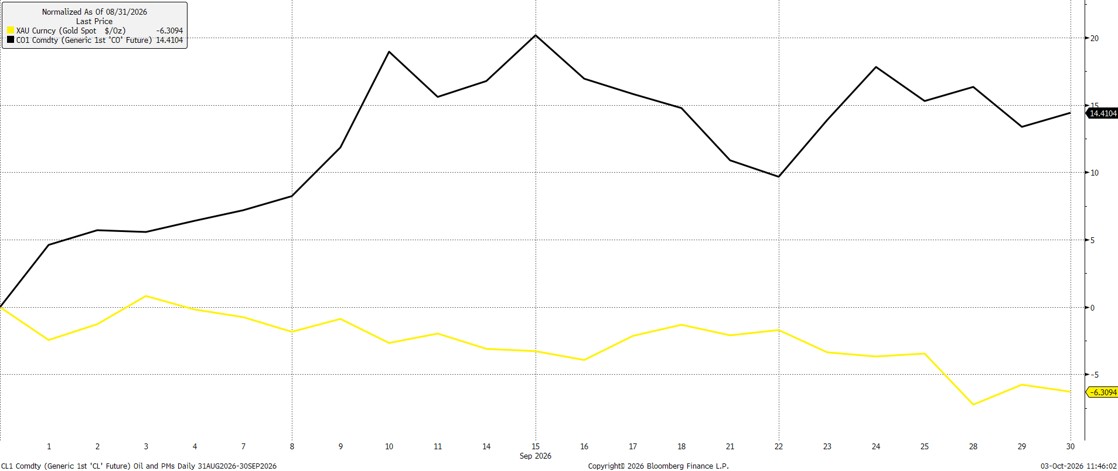
Finally, in commodities, Brent crude surged from $90.49 to $103.53 a barrel over the month – a gain of 14.4% – with the price briefly topping $107 mid-month after reports of attacks on Saudi Arabian facilities and renewed fears over Hormuz shipping disruptions. The Trump administration ordered a release from the US Strategic Petroleum Reserve late in the month in an attempt to cool prices, and Brent pulled back from its highs, but the overall monthly move was still dramatic. For UK investors, the oil surge was a double-edged sword: positive for energy stocks in the short term, but a significant driver of the inflation concerns that pushed gilt yields higher and weighed on the broader equity market.
Gold had a difficult month, falling by 6.31%. The combination of surging real yields (which raise the opportunity cost of holding non-yielding assets such as gold), a stronger dollar, and a partial unwinding of the safe-haven premium that had built up in August all weighed on the metal. Gold had briefly touched above $4,700 in August; September’s pullback was a sharp reminder that even the strongest trends can reverse quickly when the macro backdrop shifts.
September crystallised a theme that has been building all year: the world is caught between two powerful and opposing forces. On one side, geopolitical instability – the Iran situation, energy price volatility, and the knock-on effects for inflation – is keeping central banks in a hawkish corner they would rather not be in. On the other, domestic economies in the UK and Europe are clearly softening, with UK payrolls falling 26,000 in August – the sharpest drop in nine months – pointing to a labour market that is losing momentum.
For UK investors, the month’s key takeaway is the importance of currency exposure. The bifurcation in sterling’s performance meant that the same underlying equity market weakness produced very different outcomes depending on where your overseas allocations sat. Meanwhile, the BoE’s quantitative tightening pivot was a genuine positive for sterling fixed income, offering some relative shelter in an otherwise difficult month for bonds globally. With the November BoE meeting now firmly in focus and the Iran negotiations still unresolved, volatility may well persist through October.
| Match me to an adviser | Our advisers |
The value of investments may fluctuate in price or value and you may get back less than the amount originally invested. Past performance is not a guide to the future. The views expressed in this publication represent those of the author and do not constitute financial advice.
For further information, please contact:
For further information, please contact:

