
Oliver Stone

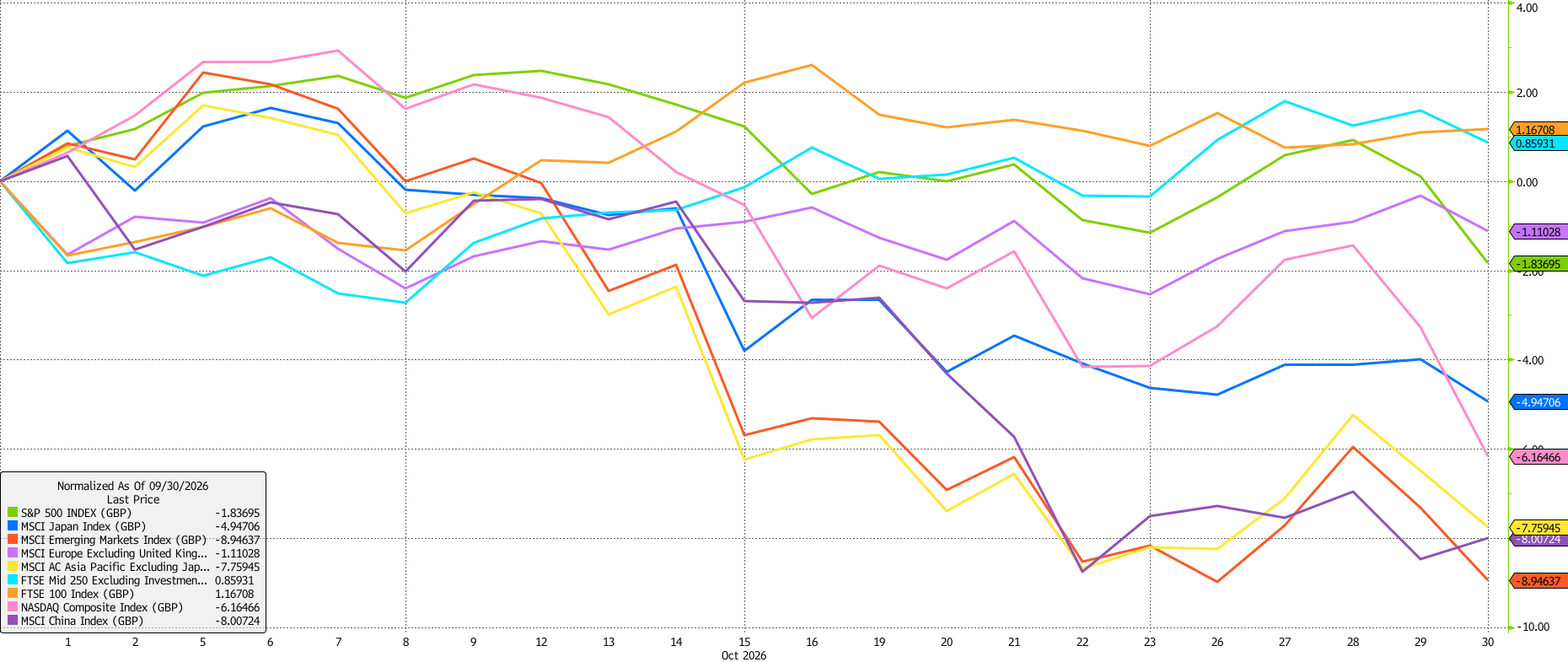
October was a month that tested investors’ nerves, and their conviction in the AI trade. A more difficult corporate earnings season for some of the world’s largest technology companies sent the Nasdaq into a technical correction, dragged global equity indices sharply lower in GBP terms, and triggered a flight to the relative safety of government bonds.
For UK investors, the FTSE 100’s old-economy composition was once again a quiet virtue, and the Chancellor’s debut budget turned out to be positive for gilts. The month’s wildcard was Brazil, where a stunning election upset sent shockwaves through emerging market assets.
The headline equity numbers for October make for uncomfortable reading in GBP terms:
But the index-level numbers mask a far more interesting story underneath. The defining feature of October was not a broad market selloff; rather it was a violent bifurcation between the world’s largest technology companies and virtually everything else. The Nasdaq 100 index fell 6.16% on the month, hitting a technical correction on an intraday basis. Yet the Dow Jones Industrial Average rose around 1% and the equal-weight version of the S&P 500 gained roughly 3.5%. That is one of the widest gaps between mega-cap tech and the rest of the market in years.
The trigger was earnings season. Alphabet’s shares fell as much as 14% on 29th October – a record intraday drop – after the Google parent failed to meet analysts’ expectations on search and advertising revenue, reigniting fears that AI is disrupting its core business rather than enhancing it. Intel suffered its worst single-day decline since at least November 1982, plunging nearly 30% on 30th October after its Q4 revenue guidance came in well below analyst expectations, hurt by a PC market slump and supply chain difficulties. Amazon’s results also disappointed on cash flow, adding to the sense that the hyperscalers are burning through capital at a pace that is starting to unsettle investors.
The contrast with the winners, however, is striking, and this is where the fundamentals story becomes important. Microsoft beat expectations convincingly, with Azure cloud revenue growing 48% year-on-year against an estimate of around 45%, and total revenue of $92.3 billion ahead of the $90.6 billion consensus. SK Hynix reported a seven-fold surge in profit, reaffirmed that shortages of the high-bandwidth memory chips critical to Nvidia’s AI accelerators are expected to persist through at least 2030, and announced plans to return approximately $45 billion to shareholders. TSMC projected Q4 sales of up to $54.3 billion – well ahead of estimates – implying full-year 2026 revenue growth of around 44%.
And Nvidia itself, while not reporting in October, has since reported, and the numbers were, once again, extraordinary. Revenue came in well ahead of consensus, with data centre demand showing no signs of deceleration, and management guidance for the coming quarter was stronger than the market had expected. Yet despite the blowout results, the stock currently trades on a forward price-to-earnings multiple of around 11 times, which, given projected 2027 earnings growth of approximately 70%, is extraordinarily cheap. To put that in context, Nvidia is cheaper on a forward earnings basis than many of the large-cap consumer staples companies sitting in the FTSE 100. The valuation compression that has taken place over the past several months means that investors are now being asked to pay a genuinely modest price for what remains one of the most exceptional earnings growth stories in the history of large-cap equities.
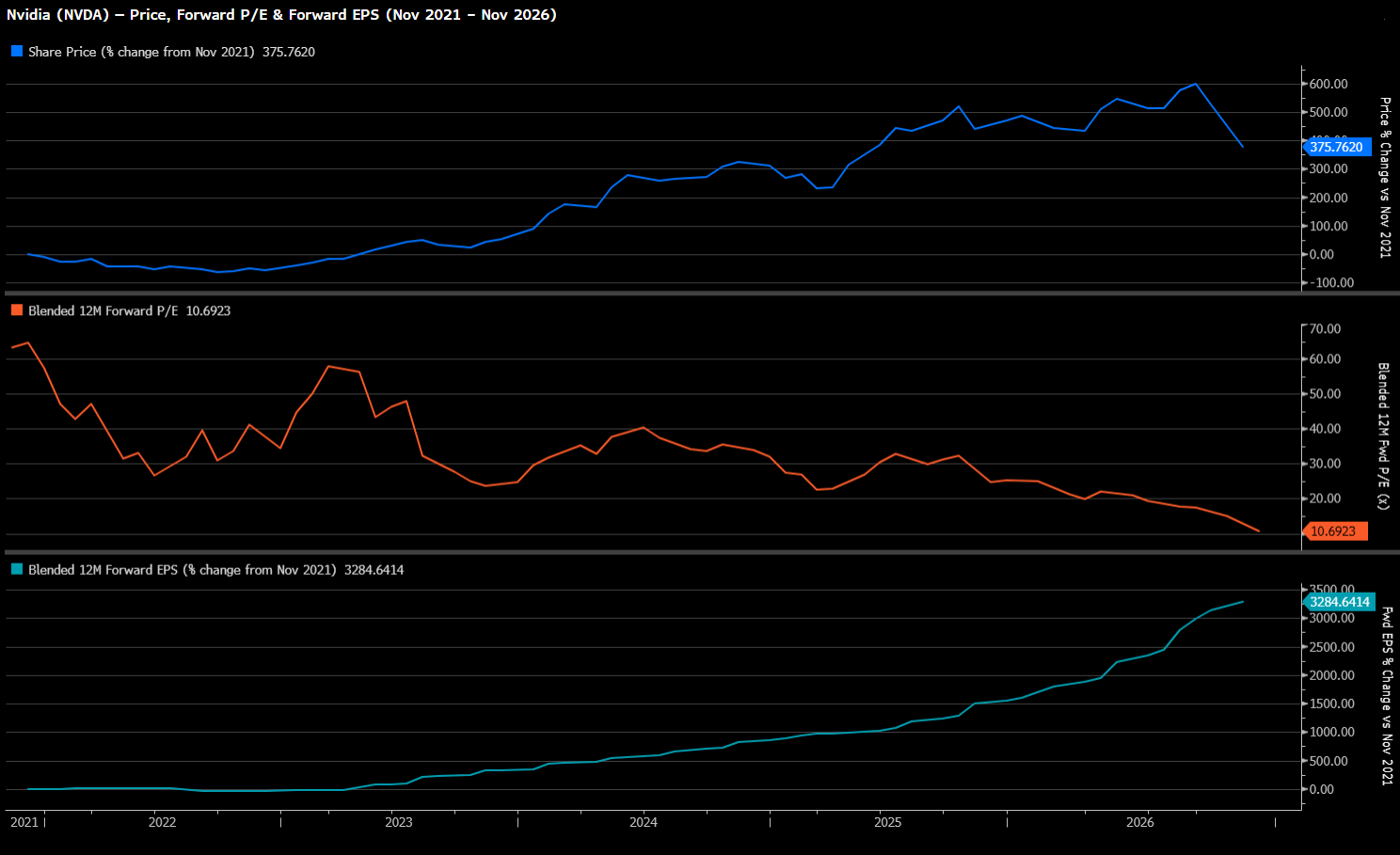
Overall, then, the AI trade is maturing and bifurcating. The companies that are genuinely delivering across areas like cloud infrastructure, memory and chip manufacturing, continue to produce great numbers. The companies that are spending heavily on AI without yet demonstrating the revenue payoff are being punished. Valuations across the sector have compressed meaningfully from their peaks, but for the quality names, the fundamental case remains intact. In our opinion, this is more a rotation and a repricing rather than a bubble bursting.
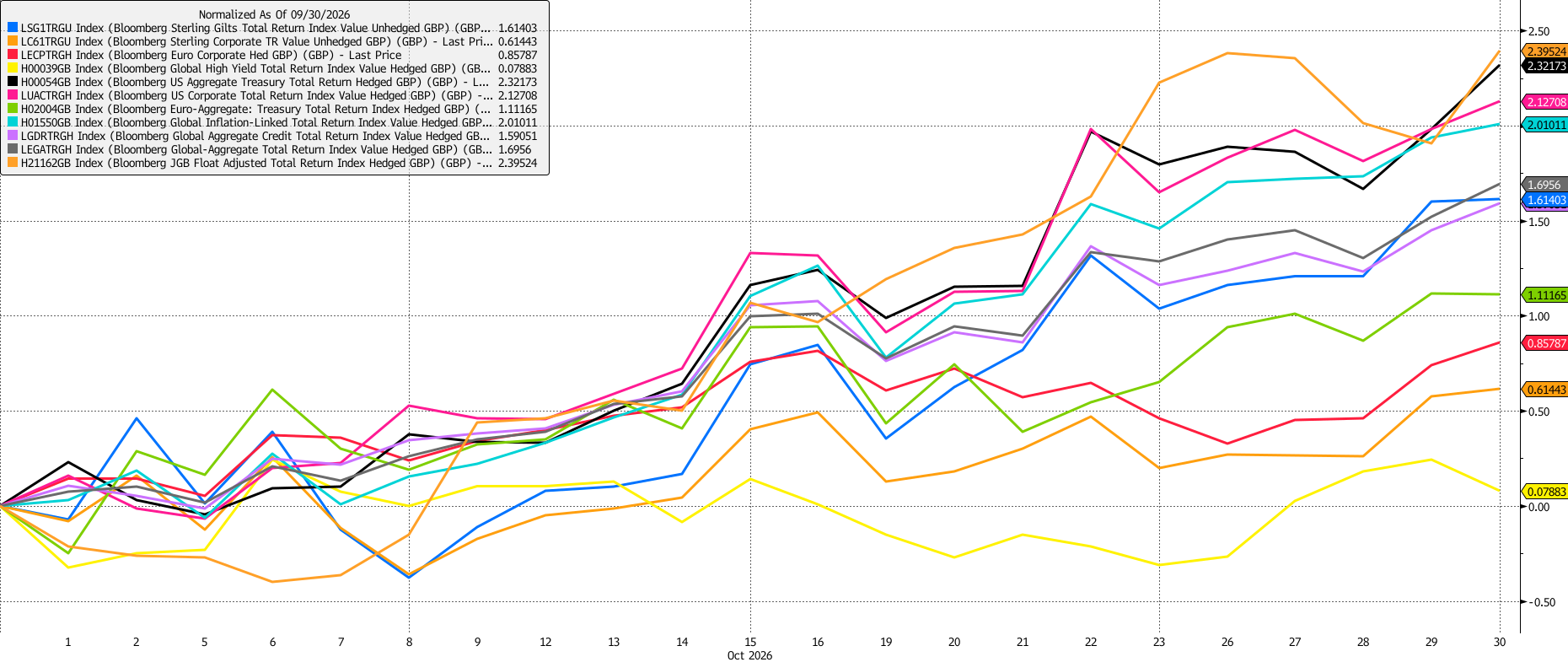
October was a good month for government bond investors, in a welcome change after months of rising yields and negative price returns. The 10-year gilt yield fell from 5.42% to 5.28%, while the 10-year US Treasury yield fell even more sharply, from 5.29% to 4.93%.
Two forces drove the bond rally. The first was the tech-driven flight to safety — as equity investors sold Alphabet, Intel and Amazon, they rotated into the relative security of government debt, pushing yields lower. The second, and arguably more important for UK investors, was the Chancellor’s debut budget on 28th October. John Healey’s first fiscal statement was widely described as a deliberate non-event, as gilt issuance of £250.6 billion for the fiscal year came in broadly in line with market estimates, fiscal headroom was maintained at around £15 billion, and the tone was one of disciplined restraint.
In general, government bonds outperformed corporate bonds, in a reversal of this year’s trend.
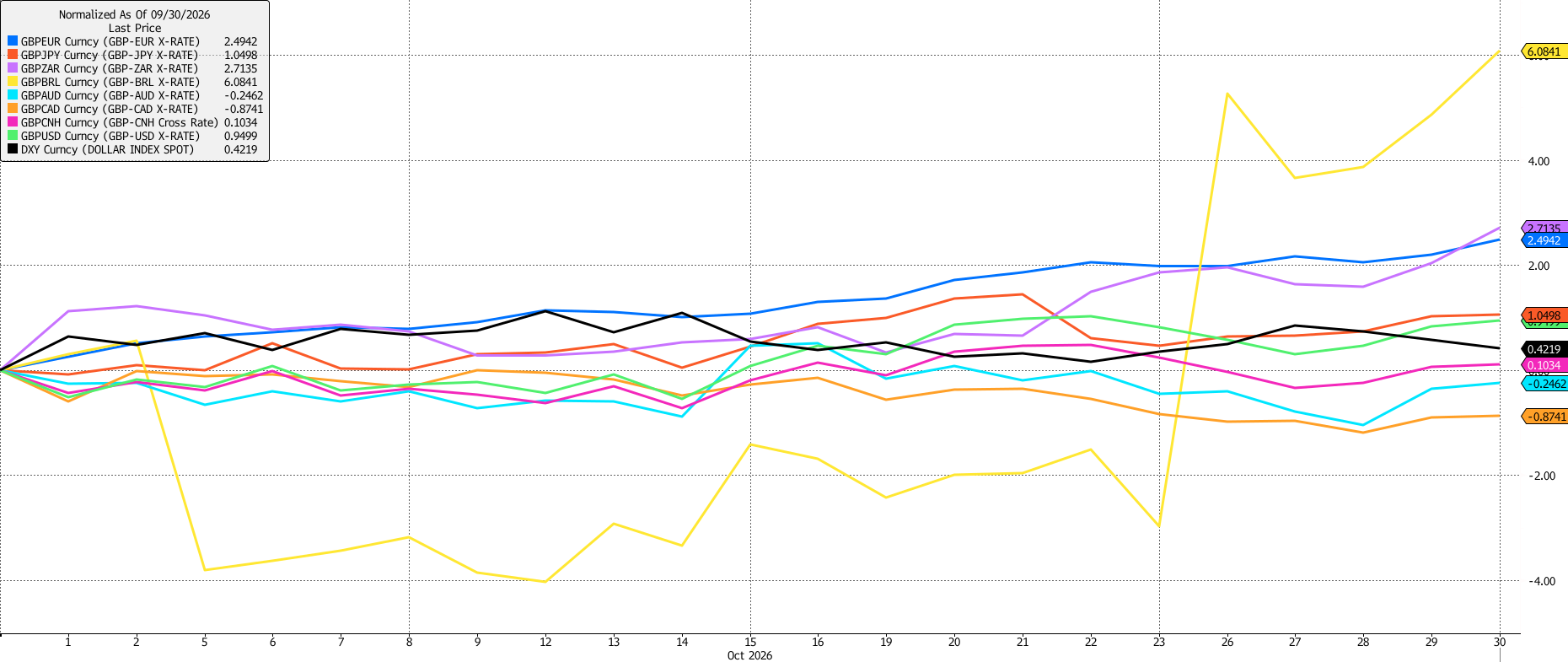
Sterling had a good month across the board. GBP/USD rose from $1.3265 to $1.3391 (+0.95%), GBP/EUR climbed from €1.1707 to €1.1999 (+2.49%), and GBP/JPY edged up from ¥208.8 to ¥211.0 (+1.05%). The euro’s weakness was notable, with commentators citing political tail risks, the potential for a widening rate differential in favour of the US, and persistently high energy prices. The ECB held rates at its October meeting but reportedly debated a December hike, leaving the euro in an uncomfortable position.
The most dramatic FX story of the month, however, was the Brazilian Real. Luiz Inácio Lula da Silva won a stunning fourth presidential term on 26th October, defeating right-wing favourite Flávio Bolsonaro – who had entered the runoff as the market’s preferred candidate – by 4.4 million votes. The Real reportedly slumped as much as 11% in a single session, its biggest one-day drop since the 1990s, triggering circuit breakers on the Brazilian stock exchange after stocks fell 10%, with some individual shares reportedly losing more than 50%. Around $6 billion in planned equity sales were reportedly derailed. By month-end, GBP/BRL had risen around 6% from 6.86 to 7.28 — meaning UK investors with any Brazilian exposure faced a meaningful additional currency headwind on top of already severe local market losses. It was a sharp reminder of the political risk premium that can materialise very quickly in emerging markets.
October crystallised a theme that will define the investment landscape heading into year-end: the AI trade is not dead, but it is being stress-tested. The companies that can demonstrate genuine revenue generation from their AI investments are being rewarded; those that cannot are being sold aggressively. For UK investors, the month’s lesson was the value of diversification – the FTSE 100’s unfashionable sector mix outperformed, gilts finally delivered positive returns, and the budget provided a rare moment of domestic political clarity. With plenty of geopolitical risk still in the air, the final stretch of 2026 promises to be anything but quiet.
| Match me to an adviser | Our advisers |
The value of investments may fluctuate in price or value and you may get back less than the amount originally invested. Past performance is not a guide to the future. The views expressed in this publication represent those of the author and do not constitute financial advice.
For further information, please contact:
For further information, please contact:

