


Savings & investment

Nick Stebbing

In times of market volatility – such as those we have seen in recent weeks – it’s natural to get nervous.
However, ups and downs in markets are a normal part of investing. Periods of uncertainty regularly cause markets to rise and fall in the short term.
Market volatility can trigger emotional responses such as fear or panic. Making decisions based on short-term emotions can lead to poor outcomes.
History shows that while markets can be volatile, they have tended to recover over time. Long-term growth has been delivered despite setbacks, recessions and global events.
Fairstone Investment Management have worked with Vanguard and J.P. Morgan Asset Management, two of our partners, to provide insight into why staying invested is normally the right thing to do.
A common reaction during market falls is to move into cash and wait for a better time to invest again.
While this may feel reassuring, evidence shows that timing the market is extremely difficult.
Some of the strongest market days often occur close to the weakest. Missing these recovery days can significantly reduce long-term returns.
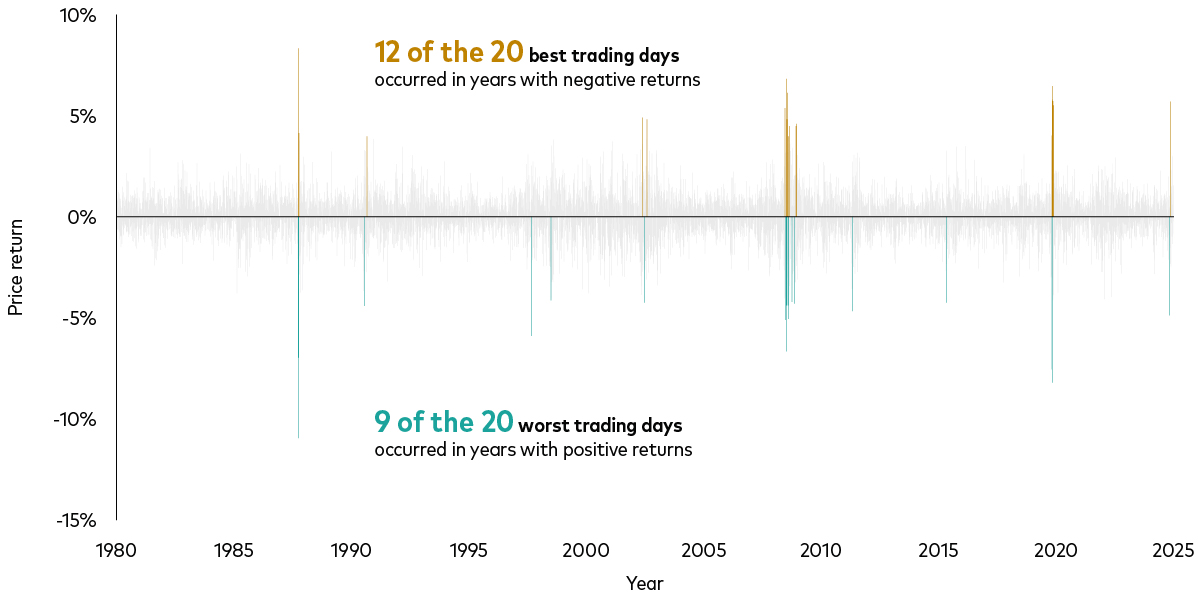
Past performance is not a reliable indicator of future results.
Source: Vanguard calculations in GBP, based on data from Refinitiv, as at 31 December 2025.
As a result, moving to lower risk investment such as cash might feel reassuring but understanding when to reinvest is a tough decision.
Long periods out of the market can reduce returns:
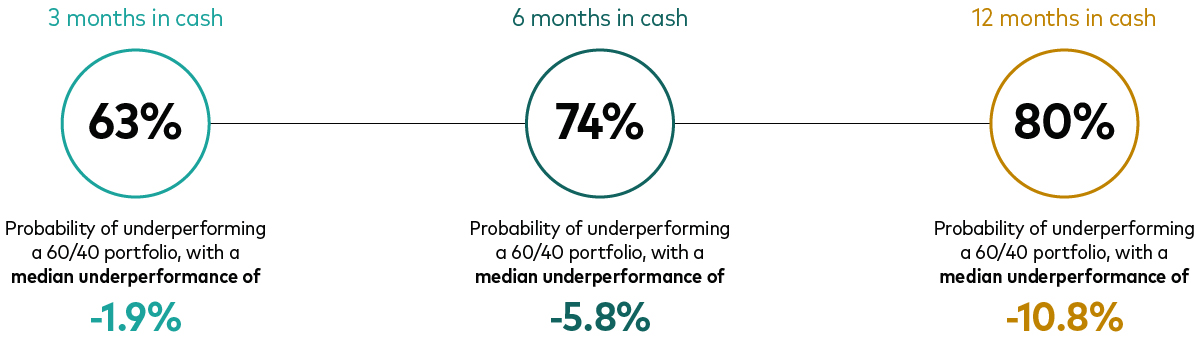
Past performance is not a reliable indicator of future results.
Notes: The chart shows the distribution of excess returns of cash over a global 60% equity / 40% fixed income portfolio for the 3-, 6- and 12-month periods after 2-month total returns of global equities were below 5%
Source: Vanguard calculations in GBP, based on data from Refinitiv, as at 31 December 2025.
Even based on valuations the day before a market downturn the returns after 1 and 3 years have usually been positive:
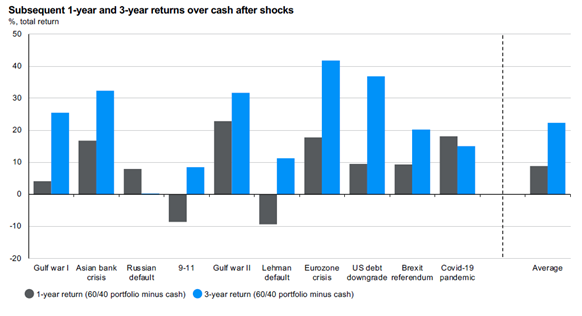
Past performance is not a reliable indicator of future results.
Source: Bloomberg, S&P Global, J.P. Morgan Asset Management. 60/40 portfolio is constructed using S&P 500 Index and S&P 10-year US Treasury Note Futures Index. Cash: ICE USD LIBOR (3M). Return calculation begins at the end of the month prior to the shock. Guide to the Markets – UK. Data as of 31 December 2024.
Holding cash can feel safe during turbulent markets, but cash comes with its own risks — particularly inflation.
Over long periods, inflation can erode spending power. Historically, diversified investment portfolios have tended to perform better than cash over time:
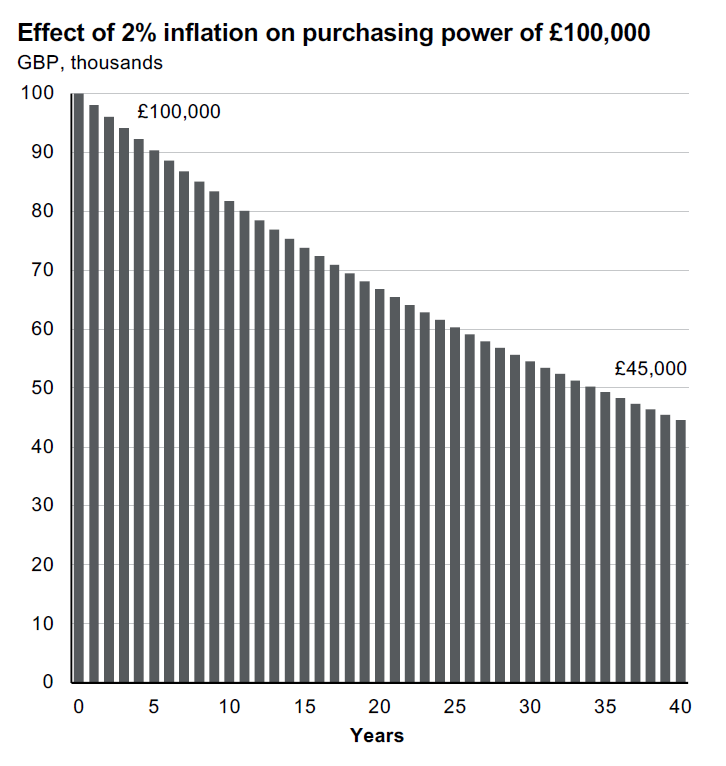
J.P. Morgan Asset Management. For illustrative purposes only, assumes no return on cash and an inflation rate of 2%. Past performance is not a reliable indicator of current and future results. Guide to the Markets – UK. Data as of 31 December 2024.
Investment plans are built to anticipate both good and difficult markets.
If your long-term goals and circumstances have not changed, short-term market movements alone rarely justify major changes.
The objective is not to avoid downturns, but to manage them sensibly in pursuit of long-term goals.
Historical performance shows value in investing in equities over the long term:
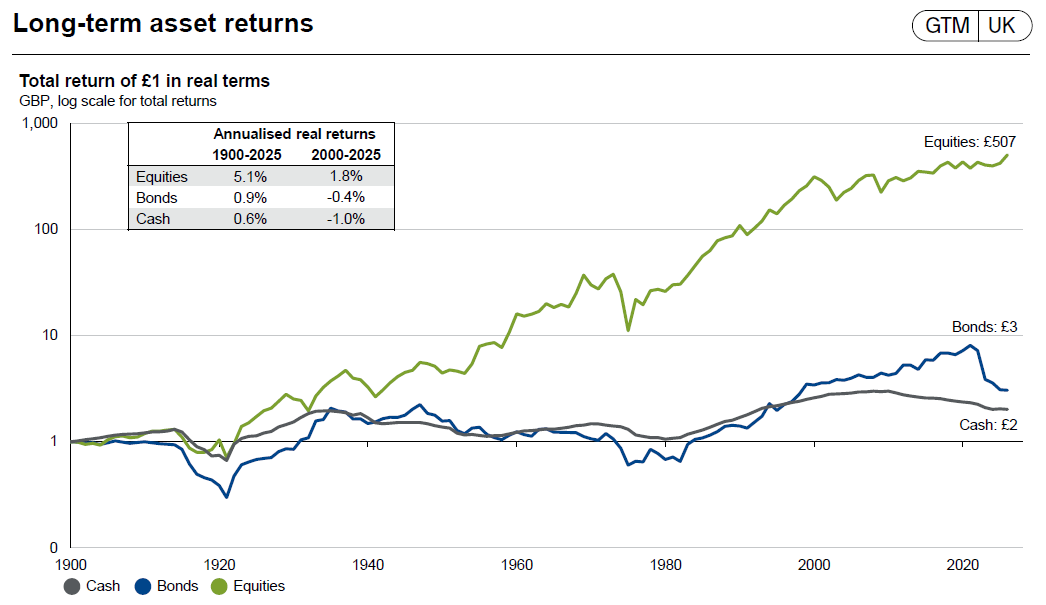
Past performance is not a reliable indicator of future results.
Source: Bloomberg, Dimson, FactSet, FTSE, J.P. Morgan, Marsh and Staunton ABN AMRO/LBS Global Investment Returns calculated from the Yearbook 2008, J.P. Morgan Asset Management. Equities: FTSE 100; Bonds: J.P. Morgan GBP Government Bond Index; Cash: three-month GBP LIBOR (prior to 2008 cash is short-dated Treasury bills). Guide to the Markets – UK. Data as of 31 December 2024.
Portfolios run by Fairstone Investment Management are managed tightly within certain risk targeted constraints.
This of course does not mean that a portfolio might not reduce in value but it does mean that downturns should be aligned with your long term goals and your own attitude to risk.
Further, our portfolios are well-diversified. Investing across different asset types and regions helps manage risk.
Diversification cannot eliminate losses, but it can reduce the impact of individual market events and support staying invested.
Market volatility can trigger emotional responses such as fear or panic. Making decisions based on short-term emotions can lead to poor outcomes.
A Fairstone adviser can help you to stay focused on goals rather than short-term market movements. If you have any concerns at all, please speak to an adviser.
Disclaimer: This article is for informational purposes only and does not constitute financial, tax, or legal advice. The value of investments can go down as well as up and you may not get back the full amount you invested. Past performance is also not a reliable indicator of future performance. Always seek professional advice before making financial decisions.
For further information, please contact:
Savings & investment

Savings & investment

Savings & investment

Savings & investment

Savings & investment

Savings & investment
For further information, please contact: