


Savings & investment

Imogen Hambly

Financial markets give investors access to an extraordinary range of companies, industries, countries and asset classes.
Yet beneath this apparent breadth, returns can sometimes be driven by a surprisingly small number of companies, themes or borrowers.
This creates an important challenge. An investment portfolio can look well diversified on the surface while still being heavily dependent on a relatively narrow set of underlying risks.
Concentration is not necessarily a reason to avoid successful companies, popular investment themes or particular markets.
Nor does it mean that today’s largest companies are automatically overvalued or destined to underperform.
Instead, it highlights why investors need to understand what is really driving their returns, how different investments interact, and whether their portfolio is providing the diversification they expect.
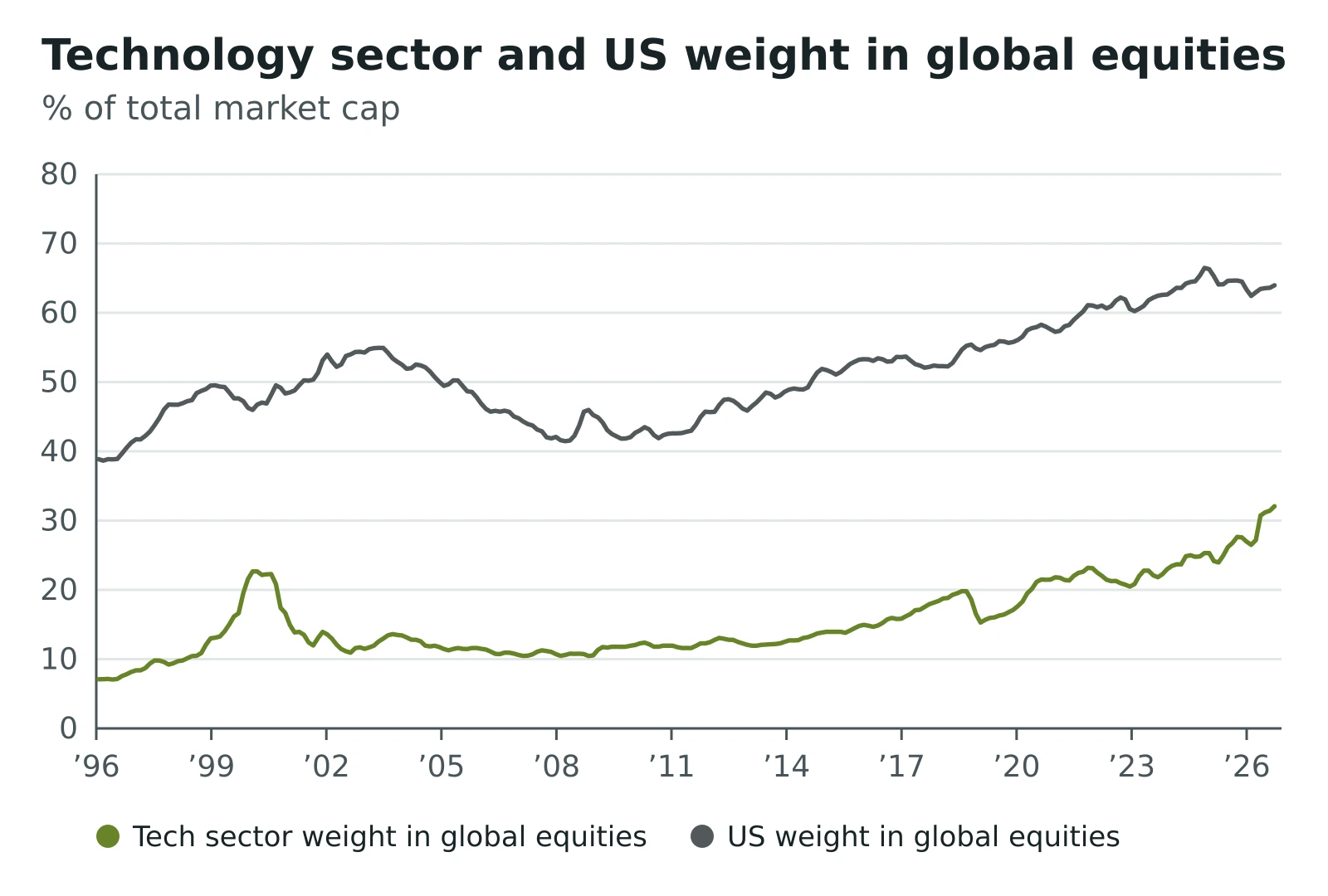
Perhaps the clearest example is the US equity market, where a relatively small group of very large technology companies has become increasingly influential.
Source: JPMorgan Asset Management
The growth of artificial intelligence (AI), cloud computing and digital infrastructure has reinforced the position of many of these businesses, with investors anticipating substantial opportunities from technological change.
This has been beneficial for investors in broad, market-capitalisation-weighted indices. As these companies have grown and their share prices have risen, they have made an increasingly important contribution to market returns.
However, the same process creates greater concentration.
Owning hundreds of companies through an index does not necessarily mean having hundreds of independent sources of return.
If a small group represents a significant share of the market, disappointing earnings, changing sentiment or a reassessment of future growth expectations can have a disproportionate effect on the wider index.
Valuations are also important. Even an excellent business can produce disappointing investment returns if its share price already reflects very optimistic expectations.
When those expectations are high, relatively small changes to the outlook can result in much larger movements in share prices.
That does not mean investors should automatically avoid the largest companies or market-capitalisation-weighted strategies.
Many leading businesses are highly profitable, possess considerable competitive advantages and generate substantial cash flows.
The important question is whether investors understand the exposure they have and how it fits alongside the rest of their portfolio.
Concentration can also arise when apparently different investments depend on the same underlying theme.
AI is a good, and well talked about, example. Investors can gain exposure through semiconductor manufacturers, cloud computing providers, software businesses, data-centre operators and companies supplying the energy and infrastructure needed to support growing computing demand.
These companies may operate in different industries and appear in different parts of an investment portfolio, but their prospects can still be closely linked.
If expectations for AI-related investment prove too optimistic, spending slows or the anticipated financial benefits take longer to emerge, the effects could extend well beyond the most obvious technology companies.
This is sometimes described as thematic concentration. A portfolio can hold many different securities while remaining unusually dependent on the success of a single economic or technological trend.
The same principle can apply to areas such as the energy transition, defence spending and emerging technologies.
These themes may offer attractive long-term opportunities, but holding them across several funds does not necessarily provide additional diversification if the underlying investments and drivers are similar.
Emerging markets have traditionally provided investors with a way to diversify equity exposure beyond developed markets, particularly the US. They offer access to different economies, currencies, industries and sources of growth.
However, looking beneath the surface now reveals a more complicated picture.
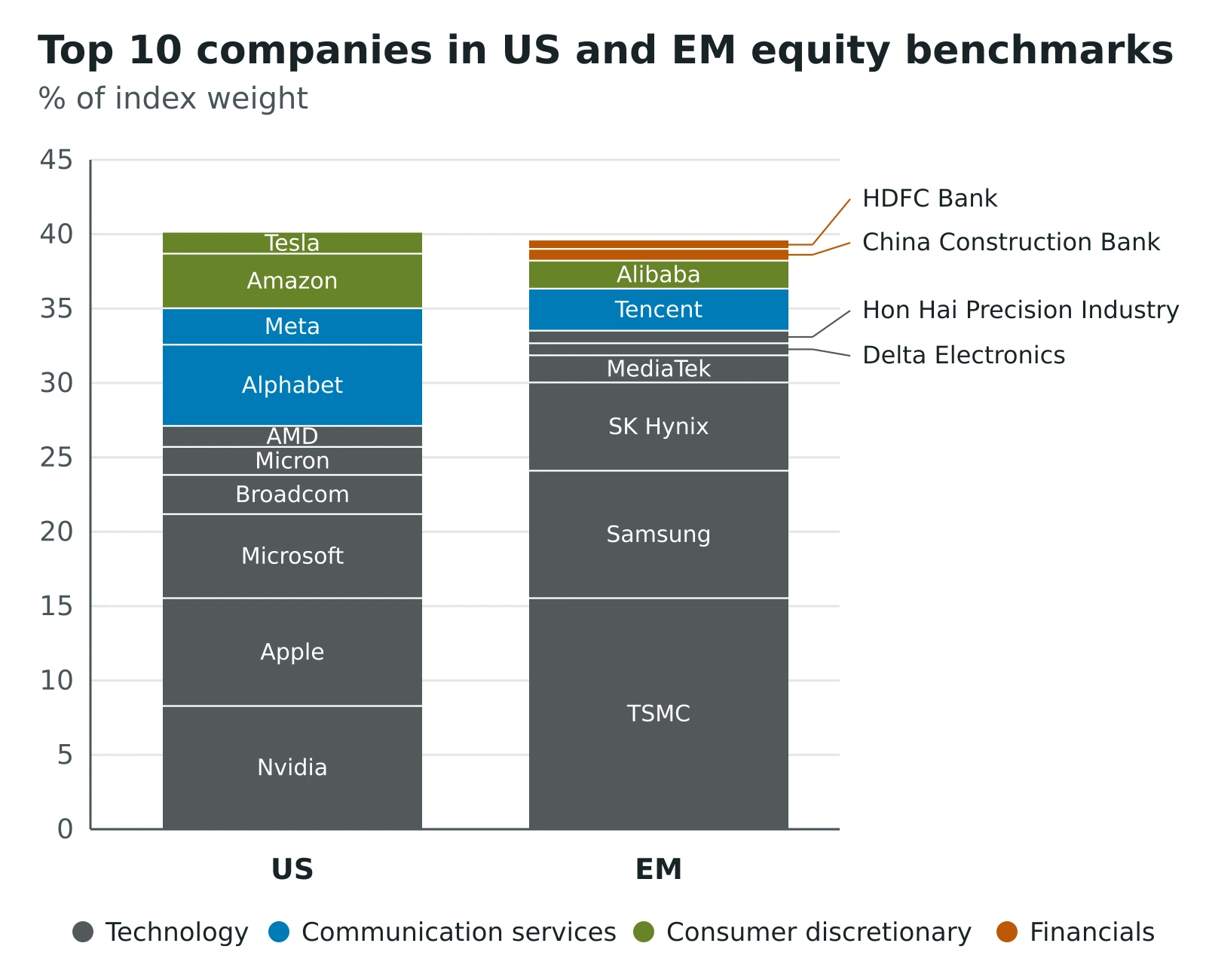
Technology businesses and companies connected to the global semiconductor and AI supply chains have become increasingly important within emerging markets.
Taiwan and South Korea, for example, are significant parts of the emerging-market investment universe, while their domestic equity markets contain several globally important technology businesses.
Source: JPMorgan Asset Management
That creates potential overlap with developed-market investments.
Semiconductor companies in Asia form a crucial part of the supply chain supporting many large US technology businesses.
An investor holding both US and emerging-market index funds may therefore have more exposure to the global technology cycle than a simple regional allocation would suggest.
This does not remove the diversification benefits of emerging markets. Their economies, currencies, domestic demand and sector mix can still behave very differently from developed markets.
But it does show why geographical diversification should not automatically be assumed to provide economic diversification.
The question is not simply where investments are located, but what ultimately drives their returns.
Similar considerations are becoming increasingly relevant within fixed income.
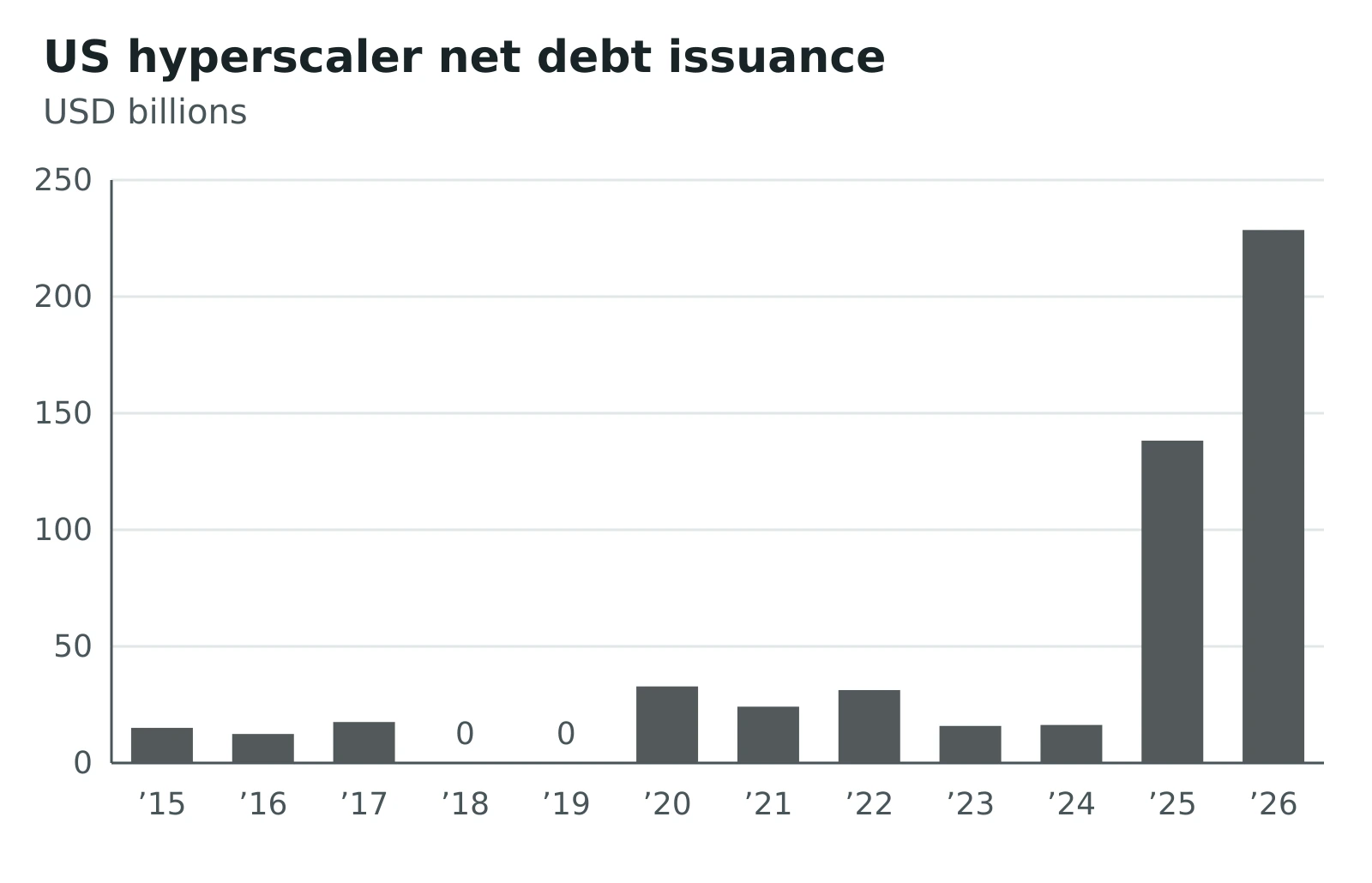
Large technology companies, including the businesses often described as hyperscalers, are investing heavily in AI infrastructure, data centres, computing capacity and cloud services.
While many have strong balance sheets and significant cash flows, the scale of this investment means debt markets now form part of their financing mix.
Source: JPMorgan Asset Management
For bond investors, this can create attractive opportunities to lend to financially strong, established companies. Corporate bonds can also broaden a fixed income portfolio beyond government debt.
However, investors may already own these same companies through their equity holdings. Buying their bonds can therefore increase total exposure to the same underlying businesses, albeit in a different form.
There is an important distinction between shares and bonds.
Shareholders participate in the potential growth of a company, whereas bondholders receive contractual interest and principal payments, subject to the issuer remaining able to meet its obligations. Bonds and equities issued by the same company can therefore behave differently.
Nevertheless, both ultimately depend on the financial health of the underlying business. If cash flows deteriorate, financing costs rise or investment plans are reassessed, both the company’s shares and bonds can come under pressure.
As before, this is not to suggest that such holdings should be avoided. Hyperscaler issuance can provide attractive, high-quality bond exposure.
Rather, the point is that a portfolio can appear well diversified across asset classes while still retaining meaningful exposure to the same underlying companies and economic drivers.
Ultimately, effective diversification is not about owning as many investments as possible.
It is about understanding what you hold, remaining focused on shifting fundamentals and combining investments that perform different roles and respond differently to changing economic and market conditions.
Holding several funds that ultimately own the same companies or depend on the same themes can create the appearance of diversification without providing all of its benefits.
The aim of a diversified portfolio is not to eliminate exposure to successful businesses or attractive long-term trends. Instead, it is to avoid becoming unnecessarily dependent on any single company, theme, region or economic outcome.
That means looking beyond fund names and asset-class labels to understand the underlying exposures within a portfolio.
What is expected to provide growth?
What is there to generate income?
Which investments could offer resilience when equity markets struggle?
And are supposedly different investments actually relying on the same underlying factors?
A well-diversified portfolio will not avoid every market downturn, and not every investment will perform well at the same time. In fact, that is partly the point. Investments that respond differently to changing conditions can help reduce the impact of weakness in any one area.
As financial markets become increasingly interconnected, diversification requires investors to look beneath the surface. The number of investments held matters less than the variety of risks and sources of return they represent.
That remains one of the most important principles in building portfolios capable of navigating an uncertain investment environment.
If you’re unsure how concentrated your portfolio is or whether it’s appropriate for your circumstances, talk to a financial adviser.
They can help you understand your current exposure and consider whether it remains aligned with your goals.
Get in touch with an adviser today to find out more.
Disclaimer: This article is for informational purposes only and does not constitute financial, tax, or legal advice. Tax treatment depends on individual circumstances and may change. The value of investments can go down as well as up and you may not get back the full amount you invested. Past performance is also not a reliable indicator of future performance. Always seek professional advice before making financial decisions.
| Match me to an adviser | Subscribe to receive updates |
Investment concentration risk is the risk of a portfolio becoming too dependent on a small number of companies, sectors, regions or economic trends. If those investments perform poorly, the impact on the overall portfolio may be greater than an investor expects.
Diversification spreads investments across assets with different sources of risk and return. It can reduce the impact of poor performance in any one area, although it cannot eliminate investment risk or guarantee positive returns.
Yes, if multiple investments create excessive exposure to the same companies, sectors or market drivers. The number of holdings matters less than how those holdings behave and the risks they share.
Review the underlying holdings of your funds, including their largest companies, sector allocations, geographic exposure and asset classes. Look for investments that repeatedly hold the same companies or rely on similar economic trends.
Global funds can broaden exposure across countries and markets, but they may still allocate a substantial proportion to the largest US companies. Investors should consider the underlying sector and company exposures as well as geographic allocation.
Yes. Shares and bonds have different characteristics, but both depend to some extent on the financial health of the issuing company. Holding both may increase exposure to that business, even when the portfolio appears diversified across asset classes.
A financial adviser can assess how your investments fit together, identify potential overlap and help you consider diversification in the context of your goals, investment time horizon and attitude to risk.
For further information, please contact:
Savings & investment

Savings & investment

Savings & investment

Savings & investment

Savings & investment

Savings & investment
For further information, please contact: