


Savings & investment

Oliver Stone

The last couple of weeks have delivered a steady stream of unsettling headlines from the Middle East.
Oil prices spiked, some equity markets fell, and commentators rushed to predict what happens next.
It’s natural to feel uneasy in moments like this. But for long‑term investors, the best response is usually the most straightforward: keep calm, stay diversified, and stick to the plan you built around your goals.
Recent military escalation in and around Iran has disrupted shipping through the Strait of Hormuz, a narrow channel that normally carries a large share of the world’s oil and gas:
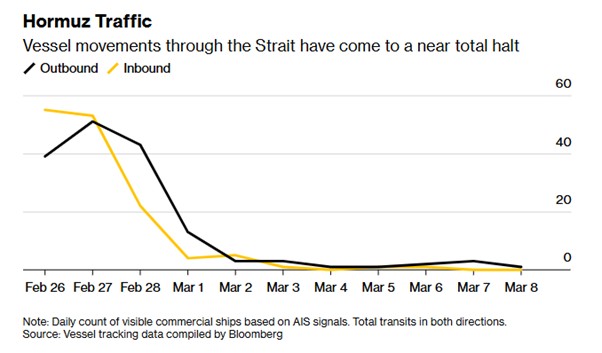
When those flows look threatened, energy prices can jump quickly and knock confidence across wider markets.
We’ve seen exactly that pattern: crude oil briefly pushed into triple‑digit territory before easing back as talk of strategic stockpile releases and naval escorts helped steady nerves.
Equity markets sold off at first, then showed signs of resilience as energy prices backed off their highs.
In short, it has been a fast‑moving situation – but not an unfamiliar one for markets.
Diplomacy continues in the background and policy responses are on the table.
Authorities have discussed reserve releases to cushion supply, and any reopening of shipping lanes would help prices normalise.
The timing is uncertain, it remains a fast-moving situation and headlines may stay volatile for a while yet.
That said, markets often adjust faster than the news flow, especially when investors can see a path to stabilisation.
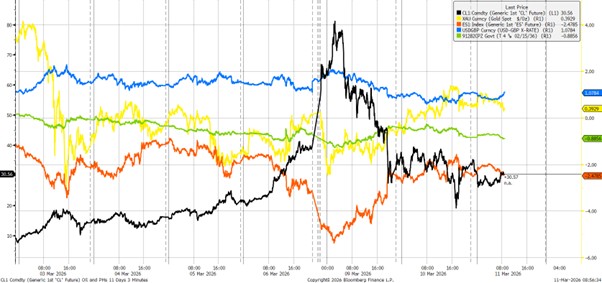
Oil jumped (black line in the chart below) as shipping slowed, before retracing a good portion of the move when signs of policy support and limited tanker escorts emerged. Large daily swings have been common.
The initial “risk‑off” reaction hit most equity regions. Energy companies outperformed on the way up, then gave back some gains as crude eased.
US equities (orange line in the chart below) have been relatively resilient versus other regions as the US is seen as less exposed to the volatility.
Government bonds (10-year US Treasuries in green line), which often rally when shares fall, were tugged in two directions – by safe‑haven demand on the one hand and by renewed inflation concerns on the other (higher oil can keep inflation sticky). That’s one reason returns have varied by market and maturity.
The US dollar firmed as investors sought safety, which matters for UK investors holding overseas assets (USD/GBP in blue line).
Gold was volatile (yellow line)—useful as a diversifier over time, but not a guarantee of gains on every risk‑off day.
As oil pulled back from its peak, market anxiety measures cooled from their initial spike, reminding us that conditions can change very quickly when policy signals improve.
None of this is to minimise events; it’s to put them in context.
Markets have navigated many geopolitical shocks over the decades, and while the path is rarely smooth, the longer‑term pattern has been one of recovery as fundamentals reassert themselves.
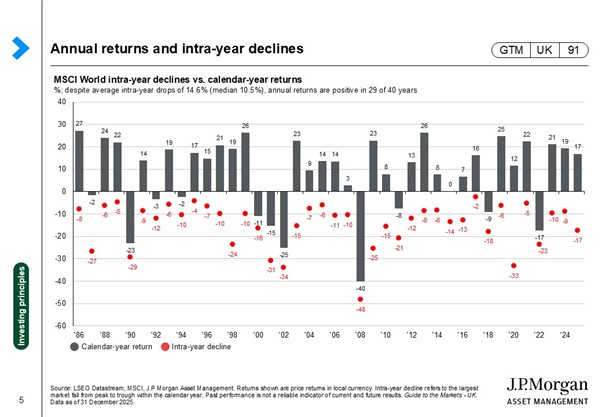
Every year experiences pullbacks. A long-running analysis by J.P. Morgan Asset Management (see chart below) shows that, despite an average intra‑year decline of roughly 15% in global equities (red dots in the chart below), calendar‑year returns (grey bars) have still been positive most of the time.
In other words, setbacks are common, recoveries are too.
Selling after markets fall often locks in losses and risks missing the recovery.
Fund‑flow data show investors tend to withdraw money near market troughs – exactly when patience is most valuable.
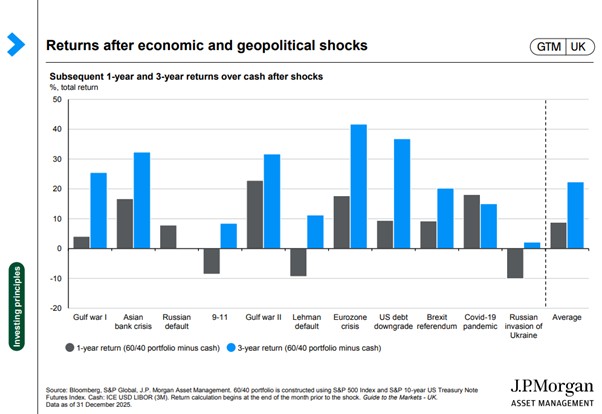
More importantly for today’s environment, the chart below shows that a simple 60/40 mix of shares and bonds has beaten cash after past geopolitical and economic shocks more than 70% of the time over the subsequent year – and every time over the subsequent three years in the sample J.P. Morgan studied:
The longer you stay invested, the lower the historical odds of losing money—particularly in a balanced portfolio.
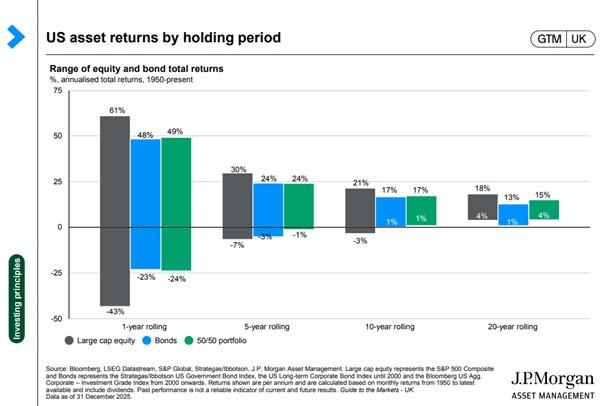
Combining time, compounding and regular reinvestment has been a powerful driver of long‑term outcomes as the final chart below shows; while over short time periods the range of returns can be wide and sometimes negative, the longer the investment time period the more predictably positive returns become.
Whilst the current time is unsettling for investors, it is important to remember that the fundamental principles of investing remain the same.
Your portfolio was built around your personal objectives and time horizon.
Short‑term market moves – especially those driven by geopolitics – don’t usually warrant wholesale changes to a long‑term plan.
A balanced approach helps cushion the journey and has historically rewarded patient investors, including through past crises.
Cash has a role for near‑term needs and as a stabiliser, but moving large amounts out of markets after shocks typically hurts long‑term results – and inflation quietly chips away at purchasing power.
Rather than making big directional calls, periodic rebalancing back to your agreed mix naturally trims assets that have risen and adds to those that have fallen, keeping risk aligned with your goals.
We are monitoring developments daily – including energy market dynamics and any policy responses – and we’ll adjust where needed within the discipline of your strategy.
If your circumstances change, please let us know so we can reflect that in your plan.
Get in touch with an adviser to discuss your current situation, any concerns you have or adjustments you’re thinking about making.
Disclaimer: This article is for informational purposes only and does not constitute financial, tax, or legal advice. Tax treatment depends on individual circumstances and may change. The value of investments can go down as well as up and you may not get back the full amount you invested. Past performance is also not a reliable indicator of future performance. Always seek professional advice before making financial decisions.
| Match me to an adviser | Subscribe to receive updates |
For further information, please contact:
Savings & investment

Savings & investment

Savings & investment

Savings & investment

Latest News

Savings & investment
For further information, please contact: